
Happy May! Happy National Preservation Month!
When my husband and I purchased our home, the seller’s agent came out to give us the final walk-through. The house itself is a 1925’s clapboard cottage in South Florida that has gone through several ramshackle “flips.” Everything in this house was in poor condition, exempting the windows which were about $15,000 of modern, impact-grade efficiency. While he droned on about how we were lucky that the soon-to-be past owners of the home invested in these windows, I tried to imagine what the house looked like with the old, eight-paned windows that lay decaying in the garage. It took me about two seconds to come to the conclusion that the house looked infinitely better before the $15,000 “improvement.” The brevity of that decision should be expected, considering the fact that I have worked in preservation/preservation-adjacent roles for the past four years.
Before he left, the seller’s agent dropped one last piece of advice for us.
“Whatever you do, don’t landmark it.”
Of all the things that I am, I am most definitely the Wrong Person to Say That To.
& Here is Why.
Let me start by saying that the historic preservation world is oversaturated with hyper-academic papers and posts that quite frankly, turn people off to the ideas that are being proposed. This isn’t that. These ideas are simple, and if we truly understand them, we should be able to explain them in digestible terms.
We have so many people telling us the woes of purchasing an old/historic/landmarked home. Here’s a different perspective, from someone who doesn’t stand to make money off of a new development and from someone who doesn’t have stock in solar panels or vinyl flooring or any of the other third-rate materials that modern homes are being built with. You don’t have to accept the false narrative that realtors and developers are preaching!
Now,
I am so exhausted with this idea that landmarking a home or purchasing a landmarked home or living in a historic district is endlessly burdensome to homeowners, realtors, developers, and everyone in between. Did you know that there have been hundreds of studies on how buildings in historic districts actually appreciate at rates greater than the local market overall as well as faster than similar, non-designated neighborhoods? I’m not just talking about in well-known historic towns like Charleston & Newport, the appreciation is consistent across the country.
Let’s take a look at Palm Beach. The Preservation Foundation of Palm Beach published a study in 2021 analyzing property values of historic buildings. It is brilliant and informative, and I highly recommend browsing through. The chart below shows the study found that not only did landmarked properties increase in value after Landmark designation, but that they increased more in value after designation than the average non-landmarked home.
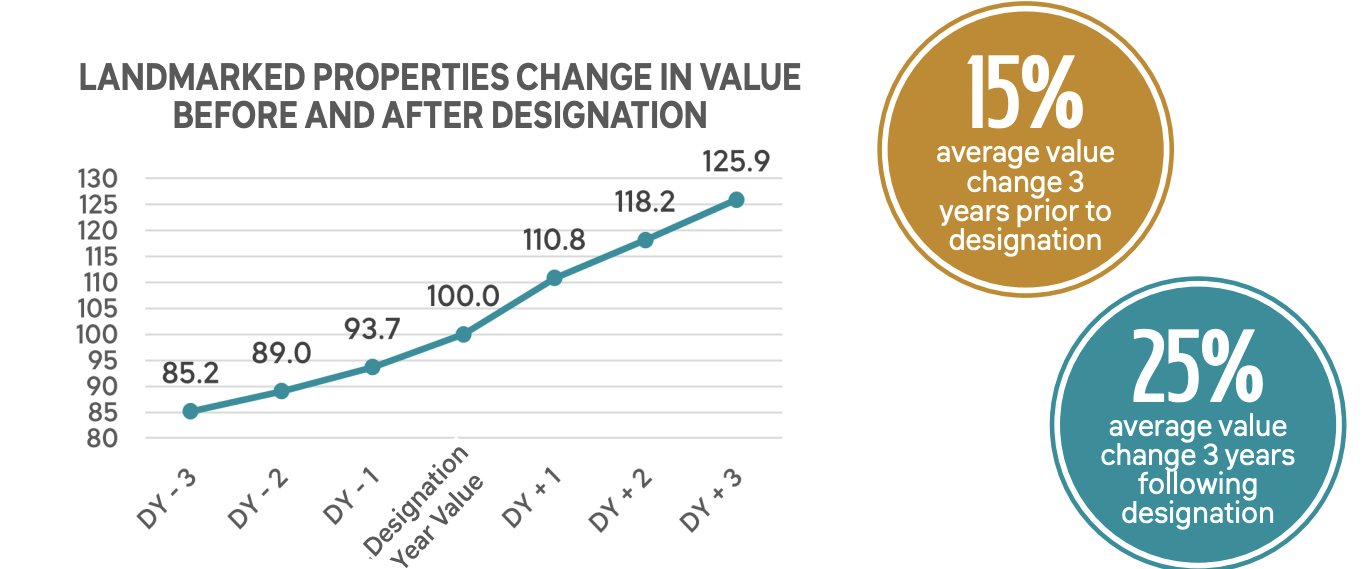
Multiple studies also found that the marketplace attaches a “preservation premium” to historic landmarked properties, meaning that a certain subset of buyers are willing to pay a premium price (typically about 5%-20% higher depending on location) for landmarked properties.
But yeah, whatever you do, don’t landmark your home.
If the fiscal part isn’t compelling enough, a note on sustainability.
- “The greenest home is the one that is already built.”
- This is infinitely true. So much of development is in the name of creating more sustainable buildings, when the reality is that the most sustainable building was probably built 200 years ago. With the exception of a tiny amount of modern utilities (a dishwasher,) historic vernacular buildings were built with their own version of modern conveniences that we spend countless dollars on buying and fixing. For instance, historic homes in Florida tend to have porches that cooled off the air before it reached the inside of the house. The windows were situated in a cross-ventilation layout that allowed the porch-cooled air to vent through the house, creating an effective air conditioning system. This is also part of the reason that lots of “Old Florida” is reliant upon trees–trees create shade which creates less of a need for cooling which uses less energy. Unfortunately, many people close in their front porches, making it often the hottest room in a house because it was never meant to be closed in–it was meant to be an area for air to freely move in and out of.
- Paned historic windows are incredibly effective if you maintain them, and having individual panes means that if they were to break, you would often only have to replace one pane and not the whole window. Instead of maintaining, most people replace with impact windows because of the promise that they are better for the cooling of your home and more resistant to hurricane damage. However, when a storm hits Florida, historic windows protected by hurricane shutters are just as effective as impact windows (even insurance sees them the same!) Also, almost every article detailing the need for impact windows is written by a window company. Look it up! Don’t let someone sell you something that you don’t want or need, especially if it’s ugly. Which it is. See this article written by Preservation North Carolina for more. Buying a modern “green” home is like purchasing a Tesla–it’s marketed to you like it is the sustainable option, when it’s really just the trendy option. In five years, no one will want your dilapidated Tesla or your energy-efficient Pulte home with two tiny windows and a garage that’s bigger than the house. It’s a trend now, but like all trends, it won’t last.
I could ramble on about the fiscal, environmental, and social benefits of historic preservation. I could quote hundreds of articles and studies that prove beyond a shadow of doubt that preservation long-term is a better option to demolition in almost every circumstance.
However, sometimes it boils down to this:
Preservation is so important to me because I love beautiful things.
I love to walk down the street and see antique windows & brackets & pediments. I want to see homes built out of stone from the 1800’s still standing, and I want to see original pecky cypress beams on porches and doors. I like when you walk in a building and the floors creak a little under the weight of centuries, and how sometimes doors don’t close perfectly right anymore because of all the wood expanding & shrinking over the years. And I know that I’m not the only one, because look at the tourism in Charleston, SC. Look at Maine, look at almost every famous museum in New York or Washington D.C. or Paris, look at Georgetown and Williamsburg and Savannah and St. Augustine. It’s all so beautiful, isn’t it?
As May winds to a close, so does Preservation Month. At Good Bones, we believe that old, beautiful buildings are worth saving, and we look forward to every old project that we get to work on.


Leave a Reply